Introduction
Choosing the right onesteel coil slitting line It's more than just choosing equipment with the right features. This is a long-term investment that can directly impact production efficiency, strip quality, material usage and operating costs. A properly set up line helps ensure consistent operation and consistent cutting results.
As demand for high-quality steel products continues to grow, manufacturers are increasingly focusing on efficient and accurate coil processing. According to the World Steel Association, global steel production has remained steady at 1.8 billion tonnes in recent years, highlighting the continued need for reliable steel processing solutions (Source: World Steel Association).
This guide focuses on four key aspects—materials, production capacity, configuration, and cutting performance—to analyze slitting line selection criteria, and offers practical strategies and a variety of equipment solutions to help you meet your exact production requirements.
Determine your steel coil processing requirements before selecting a slitting line
Before contacting suppliers, buyers must first clarify two basic questions: what materials to process and expected production capacity. Each plant has different production conditions, and if the selection is based solely on price, then there are often various discrepancies between productivity and requirements in downstream operations.
Select the cutting line according to the material type and yield strength.
Different materials require different cutting conditions. Carbon steel is relatively easy to machine, while stainless steel and high-strength steel require equipment with tougher, longer-lasting cutting tools; Aluminum coils require special care to avoid scratching the surface. Therefore the choiceslitting line you should start with fundamental parameters such as material type, thickness and strength. If the equipment is small and handles heavy materials, the outcome is easy to predict: blades will wear out faster, accuracy will deteriorate, and maintenance will become more frequent.
Determine roll thickness, width and weight requirements
Reel dimensions are another key factor when choosing equipment. The mechanical design of a production line is determined by four parameters: thickness, width, coil weight and outer diameter. In the production line, including the decoiler, slitting head, tension system and winder, every design step must meet these parameters; even a slight deviation is unacceptable.
Consider production capacity and future expansion needs
The choice of equipment also depends on performance. Small-volume processing plants have very different operating models from large service centers operating at full capacity around the clock, and their positioning and equipment requirements naturally differ significantly.
Modern withsaw slitting line must not only satisfy current production volume requirements, but also leave room for future business expansion. Features such as automated material handling, quick tool change systems and stable, continuous operation can continually pay efficiency dividends over the life of the equipment. If future expansion needs are included in planning early in the procurement process, it can significantly reduce long-term upgrade costs while minimizing production disruptions caused by subsequent upgrades.
Understanding the Key Components of a Steel Coil Slitting Line
Each link of the entire production line is interconnected, jointly determining cutting accuracy, strip stability and the quality of the finished roll. Only by deeply understanding the logic behind the operation of these components will buyers be able to go beyond the cold technical parameters in their assessment and see the true capabilities of the equipment.
Input section: Loading, unwinding and feeding system for rolls
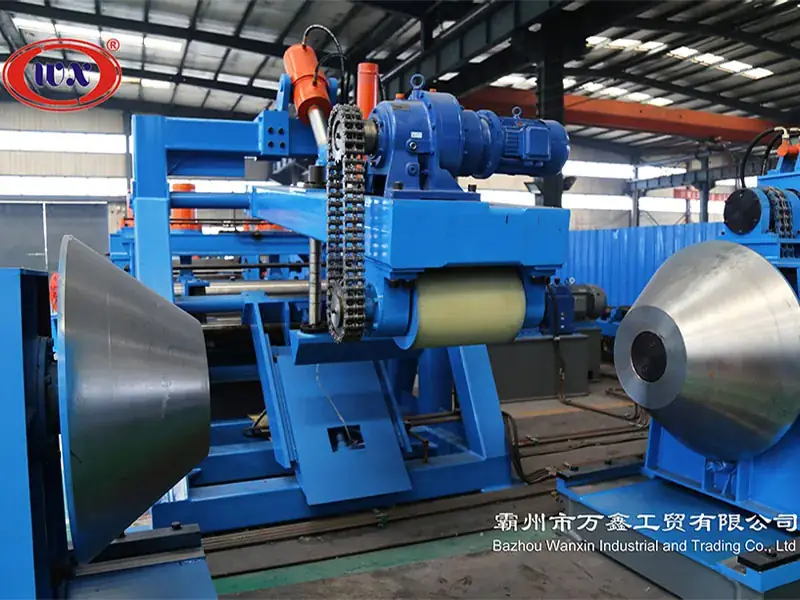
The loading section consists of a roll holder, a hydraulic unwinder, a clamping arm, a stripping machine, a pressure roller and a feeding table. From roll loading, roll ejection to leveling and feeding, each step is controlled by the appropriate equipment to ensure a stable supply of material for subsequent cutting.
A stable feeding process reduces vibration and improves strip alignment before cutting. Proper roll management is especially important when processing wider or heavier rolls, where uneven feeding can affect the accuracy of subsequent processing.
Slitting head: The basis for cutting precision and edge quality
The cutting head is the most important component of any machine tool.slitting machine because it directly determines the cutting width accuracy and edge quality.
The quality of the cutting head depends on precision-sharpened mandrels, durable rotating knives, rigid supporting structures and precise positioning of gaskets. When these components are properly aligned, the blade gap remains stable even during long-term use.
Equally important is the correct rigidity of the machine. The robust frame reduces vibration during cutting, helping to improve dimensional stability and extend tool life.
Tension and winding systems for stable strip processing
From slitting to winding, tension control must be maintained throughout the narrow strip production process. If the tension is broken, loosening of the winding, distortion and deflection will follow. High qualitysteel coil slitting machinewith Keep rolls tightly and neatly positioned with precise tension control coupled with a stable winding structure.
Improving Accuracy and Efficiency: Where to Start
How to improve cutting accuracy and production efficiency
High productivity should not come at the expense of quality. Truly competitive equipment is one that can combine high precision and high productivity over long-term operation. The semi-automatic slitting machine fits this logic perfectly: it is designed for average annual productivity, reasonable investment, stable performance and value that continuously accumulates over many years of use.
Knife clearance and its effect on cut edge quality
Knife clearance is one of the most important factors affecting cut edge quality. Improper horizontal or vertical clearance can result in excessive burrs, rollovers, edge cracking, or failure zones.
The ideal clearance depends on several variables, including material thickness, hardness and mechanical properties. As material strength increases, machine rigidity and tool quality become even more important to ensure a clean, consistent cut.
Regular inspection of blades, spacers and bearings also helps maintain consistent cutting performance over time.
Cutting speed, automation and continuous efficiency
Performance cannot be measured by top speed alone. Whether the feed is stable, whether the tension is reliable, whether the control is accurate and whether the mold changes are efficient all affect overall productivity. In addition to this, the robust design of the structure can reduce vibration and ensure long-term reliability during continuous operation.
Common Cutting Defects and Preventive Maintenance Techniques
Planned maintenance is the first line of defense in ensuring quality and preventing downtime. Operators must closely monitor tool wear, lubrication, hydraulics, bearings and alignment, promptly correcting any abnormalities to prevent minor problems from developing into major failures.
The table below shows some common production problems.
| Problem | Possible reason | Recommended Solution |
| Burrs | Incorrect knife clearance. | Adjust the knife gap and check the tool. |
| Edge waves | Uneven strip tension | Tension system calibration |
| Loose coils | Insufficient winding tension | Adjust winding settings |
| Telescopic reel | Poor strip alignment | Inspect the guide system and rewinder. |
| Scratches on the surface | Damaged rollers or contamination. | Clean or replace contact rollers. |
Preventive maintenance not only extends equipment life, but also improves production stability and reduces operating costs in the long run.
Selecting the Suitable Steel Coil Slitting Line Model for Your Production Needs
Once the requirements and configuration are clarified, the selection process has a basis. At this stage, manufacturers should not blindly chase the largest specifications, but should clearly evaluate the expected types of materials, production load, available space and room for future expansion before making a decision. Automation is not about spending more money; it's about finding the right fit. Semi-automatic slitting machines are an example of this: moderate investment, efficient operation. Fit is the true cornerstone of long-term value.
ZJ400–ZJ1000 Models for light to medium thickness steel
For manufacturers processing light to medium-sized materials, compact models typically provide an effective balance between productivity and investment.
Models ZJ400, ZJ600, ZJ800 and ZJ1000 are suitable for processing materials from 0.3 mm to 8 mm with roll weights up to 10 tons. Depending on the selected model, the width of the plates varies from 400 mm to 900 mm, and the cutting speed reaches 100 m/min.
The following models are usually selected for processing:
Carbon steel coils
· Stainless steel rolls
Galvanized steel
Aluminum sheets
Pre-painted steel
Their relatively compact footprint also makes them suitable for factories where installation space is limited, without compromising production capacity.
ZJ1250–ZJ2200 Models for heavy-duty steel coil processing
Faced with wider rolls, thicker sheets or more intensive production schedules, manufacturers often require equipment with a stiffer frame and greater load-bearing capacity.

Wanxin moreslitting line models including ZJ1250, ZJ1600, ZJ1800, ZJ2000 and ZJ2200 - cover computing power:
- Thickness: 0.3–20mm (available in light, medium and heavy configurations);
- Plate width: 900–2200 mm; Reel weight: 35t (standard) / 40t (heavy duty)
The heavy-duty configuration is designed for applications with high rigidity and stability. Reinforced frames, improved drives and precise tension control combine to ensure high-quality strip material over long periods of continuous operation. For service centers processing multiple specifications, manufacturing facilities are ready to meet demand, increasing production flexibility while saving replacement costs for future upgrades.
Key Advantages of Wanxin Steel Slitting Line
While every manufacturing facility has unique requirements, some design features directly impact overall processing performance.
The following table summarizes the main technical advantages.
| Feature | Practical benefits |
| High precision rotary shears | Improve cutting stability and reduce gap width deviation. |
| Precise guidance system | Maintains stable strip alignment during production. |
| Hydraulic separator | Provides tighter recoil and flatter strip edges. |
| Robust machine frame | Increases stability during continuous operation. |
| Wide processing range | Supports various steel grades and coil characteristics. |
| Cutting speed up to 100 m/min. | Increases productivity while maintaining quality |
Wanxin's product range covers a wide processing capacity, allowing manufacturers to select equipment according to their actual production needs.
| Model | Thickness (mm) | Roll weight (t) | Plate width (mm) | Cutting speed (m/min) |
| ZJ400 | 0.3–4.0 | 5 | 400 | 30–100 |
| ZJ600 | 0.5–4.0 | 7 | 400–600 | 20–100 |
| ZJ800 | 0.5–8.0 | 10 | 500–800 | 20–80 |
| ZJ1000 | 0.5–8.0 | 10 | 600–900 | 15–70 |
| ZJ1250 | 0.5–10 | 15 | 900–1200 | 50–100 |
| ZJ1600 | 4–12.7 | 25 | 900–1600 | 20–60 |
| ZJ1800 | 5–14 | 30 | 1000–1800 | 15–60 |
| ZJ2000 | 6–16 | 30 | 1200–2000 | 15–60 |
| ZJ2200 | 6–20 | 40 | 1200–2200 | 12.5–25 |
Instead of relying on a single configuration, Wanxin offers multiple models that can be selected according to different production capacities, material specifications and plant layouts, allowing customers to configure equipment according to practical operating requirements.
Estimating setup, installation and long-term operating costs
Buying equipment involves much more than just comparing initial offers. Total cost of ownership depends on production efficiency, maintenance requirements, labor costs, energy consumption and equipment reliability over many years of operation.
Manual, semi-automatic and fully automatic slitting line options
Different levels of automation are suitable for different production environments.
| Configuration | Suitable Applications | Benefits |
| Guide | Small production batches | Lower initial investment |
| Semi-automatic | Average production volume | Balance between efficiency and cost |
| Fully automatic | Large volume service centers | Reduced labor costs and faster changeovers |
The choice of automation level should be based on annual production volume as the main criterion, and not on a blind pursuit of technological excellence. It has been proven that in scenarios where semi-automatic devices are usedsteel slitting machines, an optimal balance between investment costs and operational efficiency can often be achieved, making it a rational choice that takes into account both practicality and cost-effectiveness.
Factory Acceptance Test (FAT) and Installation Requirements
Buyers must verify equipment performance through Factory Acceptance Testing (FAT) before shipment.
Typical inspection items include:
· Machine operation stability
Cutting width accuracy
· Quality of return
Hydraulic system performance
Electrical control functions
Safety protection devices
A comprehensive FAT program helps identify potential problems before installation and reduces commissioning time after delivery.
Installation planning is equally important. Before the equipment arrives, the buyer must first evaluate the available space in the plant, the load-bearing capacity of the foundation, connection points to public facilities such as water, electricity and gas, and the routes of entry and exit of materials. The more detailed the pre-planning, the shorter the installation period and the easier it will be to start production.
Maintenance, tool life and total cost of ownership
Long-term operating costs often exceed the original purchase price. According to the World Steel Association, improving production productivity and efficiency is becoming increasingly important as demand for steel continues to evolve (Source: World Steel Association).
Planned maintenance should include:
· Checking knives
Bearing lubrication
Hydraulic system maintenance
Electrical checks
· Alignment check
Preventative maintenance provides multifaceted benefits. Equipment life is extended, production stability is maintained, and sudden downtime becomes rare. Understanding these three aspects ensures the stability of the production line.
Frequently Asked Questions
What causes excessive burrs during steel coil slitting process?
A: Excessive burrs are usually caused by improper horizontal or vertical blade clearance, worn cutting blades, damaged bearings, or improper machine setup. Regular inspection of the tool and proper clearance adjustments help maintain clean cut edges.
How to choose between a scrap metal shredder and a scrap metal shredder?
A: Scrap balers are excellent for compact winding of thin materials at medium speeds, while scrap shredders are designed for continuous cutting of thick materials at high speeds. The choice depends on the material and the required speed.
What is the difference between loop slitting and longitudinal slitting?
A: Loop cutting compensates for tension differences due to independent grooves, improving winding quality; Long slitting saves space but requires more precise tension control for varying cutting thicknesses.
How can we prevent scratches on stainless steel or aluminum rolls?
A: To minimize damage to surface-sensitive materials, focus on four areas: using polyurethane-coated rolls, keeping the contact surface clean, setting up an appropriate tension system, and regularly removing metal debris from the production line.
Conclusion
Choosing the right oneslitting machine requires comprehensive consideration across four dimensions: material requirements, power output, configuration options, and long-term costs.
The right slitting line helps improve cutting accuracy, reduce material waste and maintain consistent production performance. By selecting equipment based on actual processing needs, manufacturers can achieve greater efficiency and reliability.
Wanxin provides customized slitting line solutions for coils of different thicknesses, widths and production requirements. With professional engineering support, customers can choose the right configuration for their current operations and future development.