Key Findings
AutomatedI-beam production line Helps steel manufacturers improve production efficiency, weld consistency and dimensional accuracy.
Selecting the appropriate equipment requires an assessment of production capacity, welding technology, level of automation and supplier capabilities.
If an I-beam manufacturing system is designed correctly, it can help reduce various problems in the manufacturing process, as well as provide reliable support for the expansion of steel fabrication projects.
Introduction
The construction, infrastructure and industrial sectors are driving strong demand for structural steel. The market is also forcing manufacturers to upgrade their solutions, demanding higher efficiency and reliability. The World Steel Association notes that the construction industry has always been a major pillar of global steel consumption. This strong demand requires stable and mature processing technologies.
For steel companies, efficient I-beam production is not just about volume. A company's competitive advantage depends directly on maintaining dimensional accuracy, controlling welding distortion, and controlling production costs.
Traditional I-beam manufacturing often involves separate processes including material preparation, positioning, welding and adjustment. While this approach can support small-scale production, it can become less effective when manufacturers require higher production capacity and more consistent quality.
IntegratedI-beam production line provides a more systematic approach to production by combining multiple production steps into one continuous workflow. Through automation and precise control, manufacturers can increase production consistency while reducing unnecessary manual adjustments.
Why traditional H–Are beam manufacturing methods becoming less efficient?
Increasing dependence on labor creates production problems
In traditional I-section steel production, different processes require different personnel. Skilled workers are needed to ensure quality, but over-reliance on manual labor limits the expansion of production scale.
As productivity increases, processing cycles become longer and quality is more susceptible to variations. The challenge is to maintain consistent product standards during mass production.
Automation helps solve these problems by increasing process stability and reducing variations caused by manual operation.
Individual production processes affect overall efficiency
In many traditional manufacturing shops, the different stages of production are performed by separate machines. Materials often need to be moved between workstations, increasing material handling requirements and requiring additional coordination work.
If the production process lacks coherence, the most direct consequence is increased preparation time and disruption to work rhythm. Particularly for manufacturers targeting large-scale engineering projects, it is more important than ever to optimize the connections between production steps.
A complete manufacturing system allows various operations to run more smoothly, helping companies improve plant productivity.
What production problems can an I-beam production line solve?
Improved welding stability and structural accuracy
The performance of I-beams largely depends on the quality of welding. In the manufacturing process, uneven heat distribution or inaccurate positioning can easily cause deformation, which directly affects the dimensional accuracy of steel components. Modern production systems are focused on increasing controllability of welding modes. High frequency welding is an effective method that reduces heat stress and improves production consistency through rapid heating and precise control. Consistent welding quality not only reduces the number of reworks, but also facilitates integration with subsequent construction stages.
Increasing production efficiency by automating the workflow
Increasing production efficiency depends on the orderly coordination of all processes. Well thought outI-beam car can reduce the frequency of manual intervention while maintaining operational stability, which ultimately helps manufacturers optimize their workflows.
Compared to individual machines operating separately, an integrated system can provide better coordination between material positioning, welding and product release.
This is especially valuable for companies with repeat orders that require consistent production speed and quality.
Reduce rework through precision manufacturing
If dimensional accuracy is insufficient, subsequent assembly becomes labor-intensive and time-consuming. If the I-beams require rework and correction after leaving the line, the company will have to incur additional labor costs and the project timeline will likely be extended.
Precision control technology helps manufacturers maintain more consistent product dimensions. By increasing precision during production, companies can reduce rework and improve overall production efficiency.
What technologies determine productivity H–Beam production line?
High frequency welding technology
The welding process directly affects production speed, product strength and production stability.
High frequency welding uses electrical heat to effectively join steel components. Compared to some traditional welding methods, it provides higher welding speeds and a smaller heat-affected zone.
The heat affected zone during welding is smaller, so deformation is naturally reduced. This is especially important for manufacturers who have stringent requirements for component accuracy.
Automatic control and accuracy control
Accurate alignment of steel webs and flanges is essential to producing quality I-beams. Small positioning errors can affect the final design and increase the need for correction.
Modern production systems use automatic control technology to maintain stable production conditions. Important factors include positioning accuracy, process coordination and consistency of operating parameters.
For companies purchasing industrial equipment, the level of automation is an important indicator as it directly affects long-term production efficiency.
How should H be assessed?–Beam production line before investment?
Purchasing an industrial manufacturing system requires a detailed evaluation rather than a simple comparison of equipment prices. For steel manufacturing companies, the most suitable solution must meet their production goals, production conditions and future business requirements.
Match production capacity with actual production needs
First, ensure that the equipment meets the required H-steel dimensions, material thickness, and expected performance.
Manufacturers must evaluate the relationship between machine capabilities and actual product requirements. Selecting equipment that is undersized can limit future production, and selecting a system that is too large can increase unnecessary investment and operating costs.
Important characteristics include beam size range, production speed, material adaptability, and production space requirements. The right configuration helps manufacturers achieve a balance between production efficiency and return on investment.
Assessing the level of automation and integration of work processes
Automation capabilities directly affect production stability and operational efficiency. A modern production system must not only increase speed, but also improve coordination between the various stages of production.
When choosing, it is important to focus on evaluating the system's performance in material positioning, weld control and production set-up. The more comprehensive the process integration, the less human intervention is required and the easier it is to maintain consistent quality during mass production.
Consider the supplier's engineering capabilities
When international buyers purchase equipment, they should focus on more than just production and delivery. Technical communication, installation support and customization capabilities are equally important as they directly impact the future performance of the equipment.
Experienced suppliers can usually offer more practical solutions based on varying site conditions and production plans. This is also worth paying special attention to when choosingPipe Production Line Manufacturer or other specialized equipment suppliers.
High Frequency I-Beam Welding Product Line
Product overview
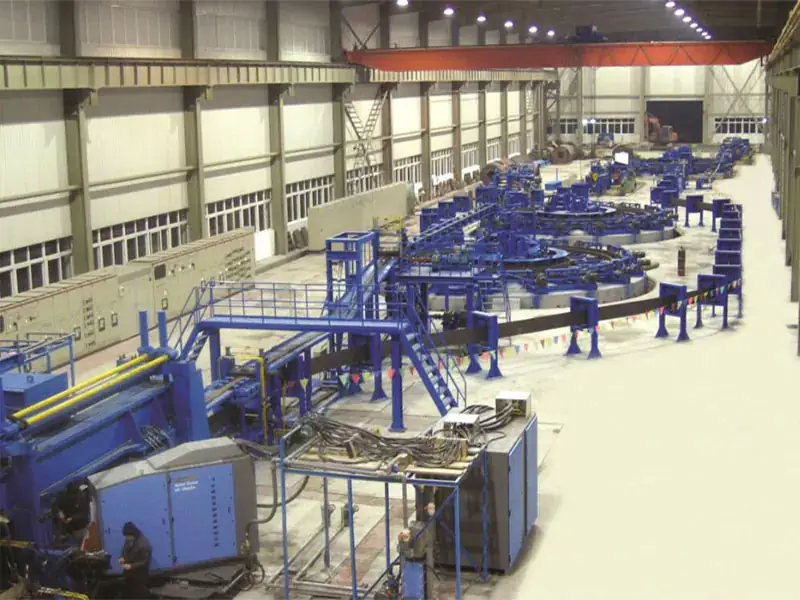
The production line for I-beams with high-frequency welding is an automated system. High-frequency welding is used to assemble the wall and flange into an I-beam. Traditional methods are characterized by scattered processes and complex relationships. This production line combines key steps to make the process smoother. The advantages of this approach are higher efficiency, more accurate dimensions and less welding distortion.
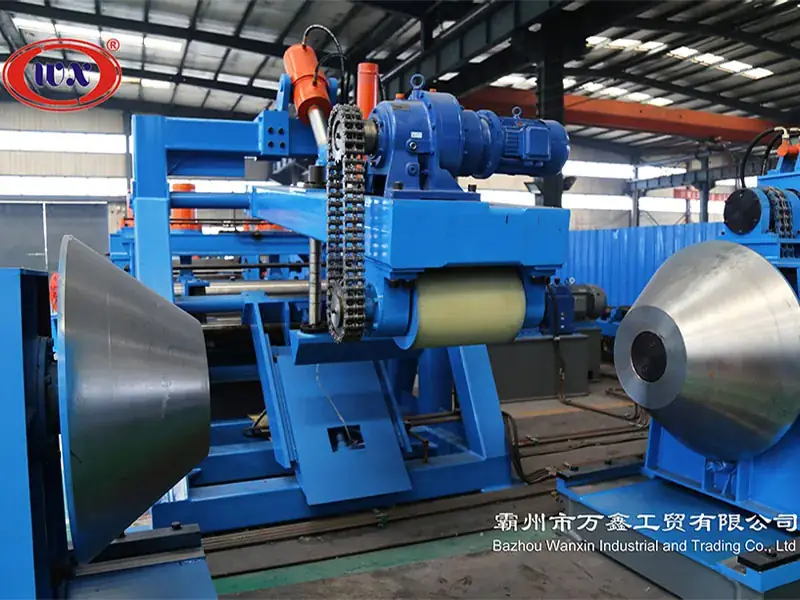
Wanxin Machinery's high-frequency I-beam welding product line can produce I-beams with a complete set of specifications, with the advantages of high production speed, high precision and small heat-affected zone.
The system is mainly designed for light steel structures and can support custom production according to user-defined specifications.

Production process and main equipment
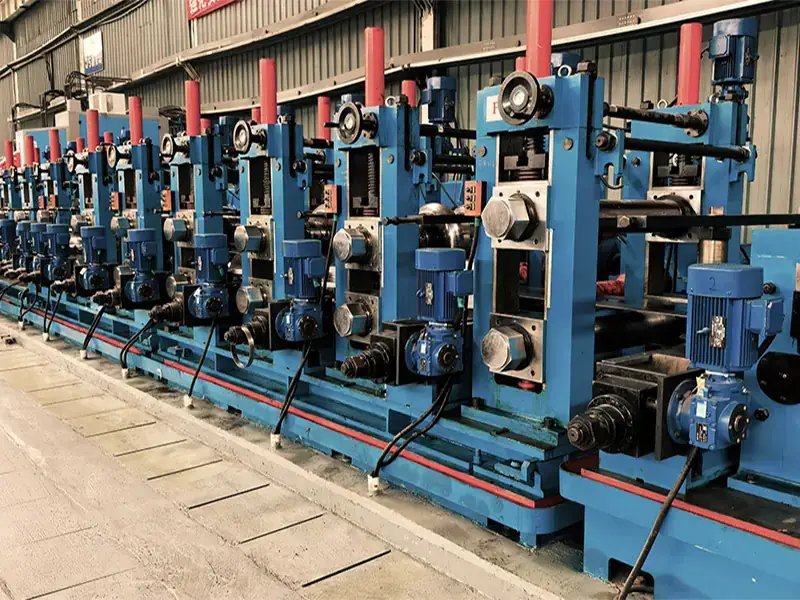
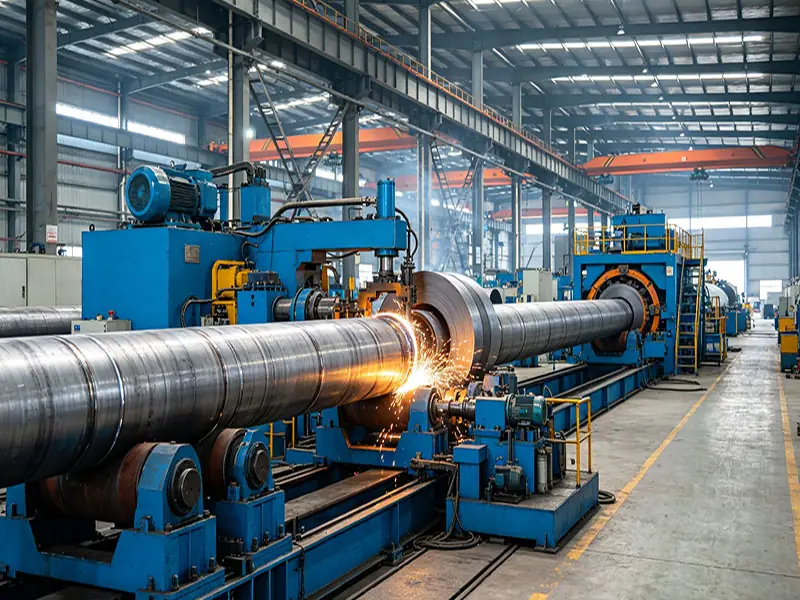
The complete I-beam manufacturing process requires precise positioning, stable welding and effective deformation control. The high frequency I-beam welding product line integrates several key processing units to perform these steps.
CNC Assembly and Positioning System
The assembly stage directly affects the dimensional accuracy of the finished I-beam. The production line uses a CNC assembly machine with automatic centering and hydraulic synchronous clamping functions to position the wall and flange plates before welding.
The system provides assembly positioning accuracy of ±0.5mm, helping to reduce alignment errors early in production and improve dimensional consistency of the finished beam.
High frequency welding system
The welding process is the main step that determines production efficiency and design quality. High-frequency welding technology allows you to quickly join wall and shelf materials while maintaining a smaller heat-affected zone.
The controlled welding process helps reduce distortion during manufacturing and ensures consistent welding performance for continuous I-beam production.
Hydraulic straightening system
The heat generated during welding can cause the flange to warp, so correction is an important part of I-beam production.
The hydraulic straightening machine uses the eccentric roll design to correct the deformation of the flange after welding. This process helps improve the geometric accuracy of finished I-beams and provides more consistent product quality.
Turnover and transfer system
Efficient material transfer is important to maintain production flow. The turning and moving system uses PLC control to perform lifting, turning and moving operations between different stages of production.
This reduces the need for manual processing and improves overall production efficiency. Compared with traditional manual transfer methods, the optimized processing process can improve production efficiency by more than 30%.
Key technical advantages
The high frequency I-beam welding product line focuses on improving production efficiency, dimensional accuracy and production flexibility.
High frequency welding technology provides high production speed and small heat affected zone, which helps reduce welding distortion. Micro tension control technology improves product accuracy and section performance during production.
The system supports welding of various types of materials and can produce custom I-beam products according to customer requirements.
For dimensional control, the manufacturing process can achieve ±0.5mm wall thickness tolerance, ±2mm flange width tolerance, and ±50mm length tolerance. Under suitable operating conditions, the welding process can achieve weld inspection pass rates of 99.9% or higher.
Product Specifications
The high frequency I-beam welding product line includes several models designed to meet different I-beam production requirements.
| Model | Blade height/H (mm) | Shelf width B (mm) | Blade thickness | Flange thickness | Length (m) | Reel weight (Mt) | Production speed(m/min) |
| H100 | 60-100 | 50-75 | 2.0-3.0 mm | 2.3-4.0 mm | 6-15 | 3 | 20-45 |
| H250 | 100-250 | 50-150 | 2.5-4.5 mm | 3.0-6.0 mm | 6-15 | 6 | 15-40 |
| H500 | 150-500 | 75-250 | 3.0-6.0 mm | 3.0-9.0 mm | 6-15 | 10 | 8-35 |
| H600 | 150-600 | 75-300 | 3.0-10.0 mm | 1.5-14.0 mm | 6-15 | 12 | 8-30 |
| H800 | 200-800 | 100-400 | 3.0-12.0 mm | 4.5-16.0 mm | 6-15 | 15 | 8-30 |
Typical Production Improvement Scenario
Many metal fabricators face problems such as repetitive manual adjustments, inconsistent positioning accuracy, and inefficient material movement during I-beam production.
By integrating assembly, welding, straightening and transport processes into one production system, manufacturers can create a more organized workflow. The improved process helps reduce unnecessary handling, maintain consistent product dimensions and support continuous batch production.
For companies producing steel structures for buildings, bridges, industrial facilities and infrastructure projects, improving production consistency is often critical to meeting increasing project demands.
Frequently Asked Questions
1. What isI-beam production line?
A: The I-beam production line is an automated production system used to produce H-shaped steel beams by welding steel webs and flanges. It integrates multiple manufacturing processes to improve efficiency, accuracy and product consistency.
2. What are the advantages of high frequency welding in the production of I-beams?
A: High frequency welding provides higher production speed, smaller heat affected zone, reduced distortion and consistent welding performance. These advantages help manufacturers produce I-beams of consistent quality.
Question: How to solve the problem of uneven flange thickness when producing I-beams?
A: Roll gap error is compensated by offset screen method. Pre-setting the specified rolling size compensates for the deviation of rolling processing, thereby restoring the thickness of the I-beam to a stable value.
4. Can the high frequency welding I-beam production line produce customized products?
A: Yes. The production line can support customized solutions according to customer specifications, including different beam sizes, material requirements and custom product designs.
Conclusion
The choice of production system lays the foundation for the efficiency and future development of steel fabrication plants. goodI-beam production line can not only ensure smoother processes, but also guarantee consistent welding quality while reducing fluctuations caused by manual operations.
Before making a decision, buyers need to comprehensively evaluate equipment specifications, automation configurations, production requirements, and vendor support. Only when the system meets the needs can the enterprise truly increase its competitiveness in the production of metal structures.
If you are looking for a high frequency I-beam welding solution, contact us to discuss your production requirements and find a suitable configuration.