Key Findings
Electroplating equipment is a complete production system used to apply a protective zinc coating to steel products through hot-dip galvanizing processes.
Choosing the right oneElectroplating plant requires evaluation of workpiece size, production capacity, automation requirements, and environmental conditions.
Modernhot galvanizing equipment integrates pre-treatment, galvanizing, material handling and contamination control systems to improve coating consistency and operational safety.
A properly designed system helpselectroplating plant achieve stable production while reducing long-term maintenance and operating costs.
Introduction
Steel structures used in construction, power transmission, transportation, and industrial applications are often exposed to moisture, chemicals, and the environment. If corrosion protection is insufficient, the frequency of maintenance and replacement will increase, resulting in increased life cycle costs.
Hot-dip galvanizing is one of the most common methods of corrosion protection. The steel is dipped into molten zinc where a metallurgical reaction occurs to form a durable zinc coating. The ISO 1461 standard defines the requirements and methods for monitoring the galvanized layer. Among the various types of galvanizing, overhead galvanizing equipment is widely used for serial processing of steel components of various shapes and sizes, making it an important option for manufacturers working with prefabricated steel structures, towers and other industrial components.
If a company is planning to build a new or upgrade an electroplating production line, choosing equipment involves more than just purchasing machines; it is more about whether production efficiency can be improved, quality can be stabilized and future production capacity can be smoothly expanded.
What is galvanizing equipment and how does hot dip galvanizing plant work?
Understanding the Role of Galvanizing Equipment
Electroplating equipment refers to an integrated system designed to clean steel surfaces, immerse the prepared parts in molten zinc and create a protective zinc coating. Unlike simple plating methods, hot-dip galvanizing creates a layer of zinc-iron alloy that provides long-term corrosion resistance.
The complete system usually includes pre-treatment, galvanizing, material handling and environmental protection sections. Configuration may vary depending on the type, size and production requirements of galvanized products.
For steel fabricators, equipment selection must match the characteristics of the products being processed, such as beams, towers, guardrails, bridge components and finished steel parts.
Basic process of hot dip galvanizing installation
A typical galvanizing process involves several controlled steps. Each stage directly affects the quality of the final coating.
| Process stage | Main goal | Key Equipment |
| Degreasing | Removing oil and surface contaminants | Degreasing tank |
| Washing with water | Clean up chemical residues | Wash tank |
| Acid etching | Remove rust and oxide deposits | Pickling tank |
| fluxing | Improve zinc adhesion | Flux tank |
| Drying | Reduce humidity before dipping into zinc. | Drying system |
| Galvanization | Creation of zinc protective coating | Zinc kettle and heating system |
| Cooling and inspection | Check the quality of the coating | Cooling and inspection area |
The galvanizing process must be carefully controlled as insufficient surface preparation or unstable galvanizing temperatures can affect adhesion and uniformity of the coating.
Hanging galvanizing equipment: Flexible solution for serial processing of steel
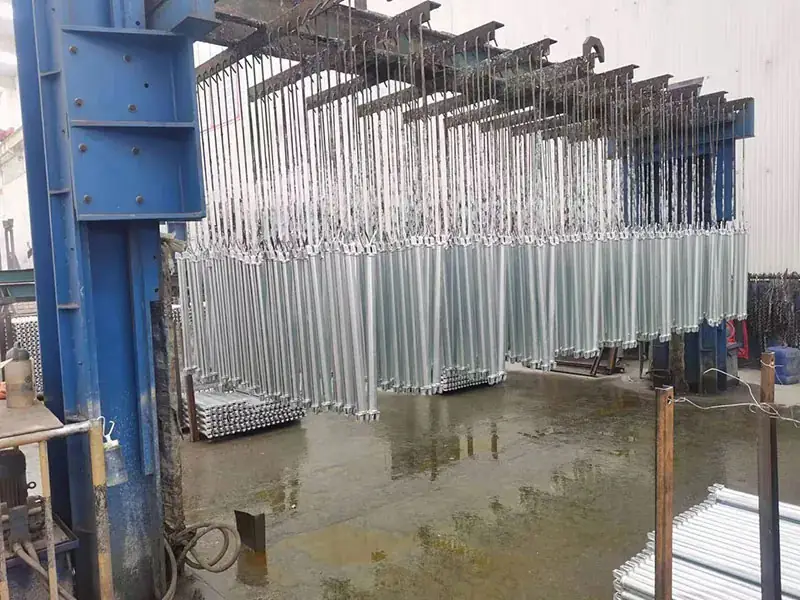
Hanging galvanizing equipment is a specialized type of hot-dip galvanizing system designed to process individual steel components by hanging them during the pre-treatment and galvanizing stages.
Compared to continuous galvanizing lines designed for coils or long products, overhead systems are generally suitable for batch galvanizing of finished steel components of various shapes, sizes and weights.
This makes them widely used for products such as:
- Beams and columns of steel structures
- Power transmission towers
- Road barriers
- Bridge components
- Welded steel assemblies
Basic structure and performance characteristics of suspended galvanizing equipment
A complete suspended galvanizing system usually includes several functional sections:
| System | Function |
| Pre-treatment system | Removes oil, rust and surface contaminants before galvanizing. |
| Drying system | Reduces moisture before zinc dipping. |
| Zinc kettle and heating system | Provides controlled conditions for molten zinc |
| Handling and transport system | Transfers workpieces between different process steps. |
| PLC control system | Helps monitor and manage production processes |
Key technologies and standards for hot-dip galvanizing equipment
Choosing the right system requires not only taking into account production capacity, but also understanding the technologies that affect coating quality, energy consumption and service life.
Pre-treatment system and surface preparation
The pre-treatment step is one of the most important steps in the hot-dip galvanizing process. Before steel parts enter the galvanizing bath, surface contaminants such as oil, grease, rust and oxide scale must be removed.
The complete pretreatment process typically includes degreasing, rinsing, acid pickling and fluxing. Proper surface preparation improves zinc adhesion and helps achieve a more uniform protective coating.
The pre-treatment process depends on the condition of the steel. Different surface conditions, contamination levels and production requirements require different processing methods. A well-designed system ensures thorough cleaning, preventing coating problems caused by residues.
Zinc kettle design and temperature control
The reaction between steel and zinc mainly occurs in a zinc bath. If the bath temperature fluctuates too much or the immersion time is not properly controlled, the quality of the resulting coating will be difficult to maintain consistently.
When assessinghot galvanizing equipmentManufacturers should pay attention to:
| Evaluation factor | Why is this important |
| Temperature stability of zinc | Helps maintain uniform coating formation. |
| Kettle size | Determines whether large components can be completely submerged in water. |
| Heating system efficiency | Impacts energy consumption and operating costs |
| Dive control | Affects coating thickness and surface quality. |
A suitable zinc boiler configuration must match the expected workpiece size, not just the current production requirements.
Environmental protection and energy efficiency
Environmental compliance is becoming increasingly important in modern galvanizing processes. A comprehensive system must take into account acid mist collection, zinc vapor control and wastewater treatment.
For modernElectroplating plantEnvironmental protection systems are not optional accessories, but important components that affect long-term performance and regulatory compliance.
Energy efficiency is also important because heating molten zinc requires constant energy consumption. Optimized furnace design, insulation measures and heat management systems can help reduce unnecessary energy loss during operation.
How to choose the right galvanizing equipment for your production needs?
Selecting the right equipment requires more than just checking the machine's specifications. Manufacturers need to assess their actual production needs before investing.
Consider the type, size and weight of the workpiece.
The first step is to identify the products that will be processed. Different steel components require different hardware configurations.
When working with large steel structures, the deciding factors are the size of the galvanized gutters, the lifting capacity of the lifting equipment and the workshop area. Power pole manufacturing also requires consistent quality between batches because if the coating is uneven, it can accelerate failure in outdoor environments exposed to wind and rain.
The maximum length, width, height and weight of workpieces directly affect:
- Effective Size of Zinc Kettle
- Hanging distance
- Load capacity
- Production scheme
Failure to match product dimensions to equipment capacity may result in inefficient operation or additional processing steps.
Match production capacity to factory requirements
Production planning is another important factor when selecting a system forelectroplating plant. Equipment should be selected according to current performance requirements with future expansion in mind.
Key assessment factors include:
- Daily Processing Capacity
- Galvanizing cycle time
- Number of hanging places
- Required level of automation
For example, a plant processing large volumes of steel components may benefit from automated material handling systems, while manufacturers may require more flexible configurations.
Assessment of automation and security requirements
The level of automation directly affects production stability and labor safety. Traditional manual methods can create variations between production batches, while automated systems can provide more consistent process control.
Modern solutions may include PLC-based controls, automated lifting systems and production data recording. These features help operators control production parameters and reduce direct exposure to high-temperature galvanizing and chemical processing zones.
Wanxin Suspended Galvanic Equipment for the Production of Anti-Corrosion Protection of Steel Structures
After evaluating production requirements, process technology and application conditions, manufacturers can select the appropriate equipment solution according to their actual needs.
Wanxin Hanging Galvanizing Equipment is designed for the production of anti-corrosion protection for steel structures and can be configured to meet various workpiece requirements. The equipment is mainly used in industries that require hot-dip galvanizing of finished steel parts.

Product Configuration and Workflow
The system integrates several sections required for the galvanizing process, including pre-treatment, heating, galvanizing and material transport.
A typical workflow includes:
- Preparing steel parts and cleaning the surface
- Pre-treatment by degreasing, washing, pickling and fluxing.
- Drying before entering the zinc bath
- Controlled Dip Galvanizing Process
- Cooling and quality control
The configuration can be customized according to the size, weight, production capacity and plant layout.
Key benefits for industrial production
Compared to traditional manual handling methods, modern overhead systems provide better process control and production control.
Key benefits include:
- More consistent coating quality thanks to controlled operating procedures
- Increased production efficiency through organized material handling.
- Reduces operator exposure to chemical processing and high temperature galvanizing areas.
- Simplified production control using automated control systems.
For companies planning to build or modernizeElectroplating plantSelecting equipment that suits current production conditions and future expansion plans is important to achieving stable operation.
Frequently Asked Questions
Question 1: What products can be processed by overhead electroplating equipment?
A: Overhead galvanizing equipment is mainly used for the production of non-overhead parts, including steel structures, screws, bolts, power poles, fencing, bridge components and fabricated metal parts. The final equipment configuration depends on the size, weight and production requirements of the product.
Question 2: How to choose suitable hot-dip galvanizing equipment for my factory?
A: The selection should take into account workpiece size, production volume, automation requirements, environmental regulations and future expansion plans. A properly designed solution must balance production efficiency, coating quality and operating costs.
question3: What are the benefits of switching to an automated galvanizing system?
A: Automated systems can improve process consistency, reduce manual labor, improve workplace safety and support production data management. They are especially beneficial for factories running multiple batches or large production volumes.
Conclusion
Choosing the right oneElectroplating equipment requires a comprehensive assessment of product characteristics, production goals, process requirements, and environmental considerations.
A reliable solution must not only provide corrosion protection, but also ensure efficient production, consistent coating quality and long-term performance. For companies wishing to create or modernizeelectroplating plantSelecting the appropriate overhead galvanizing equipment configuration is an important step towards achieving sustainable production performance.
If you are planning to build or upgrade your galvanizing production line,contact us for a customized galvanizing overhead solution designed to suit your product requirements and production goals.