Introduction
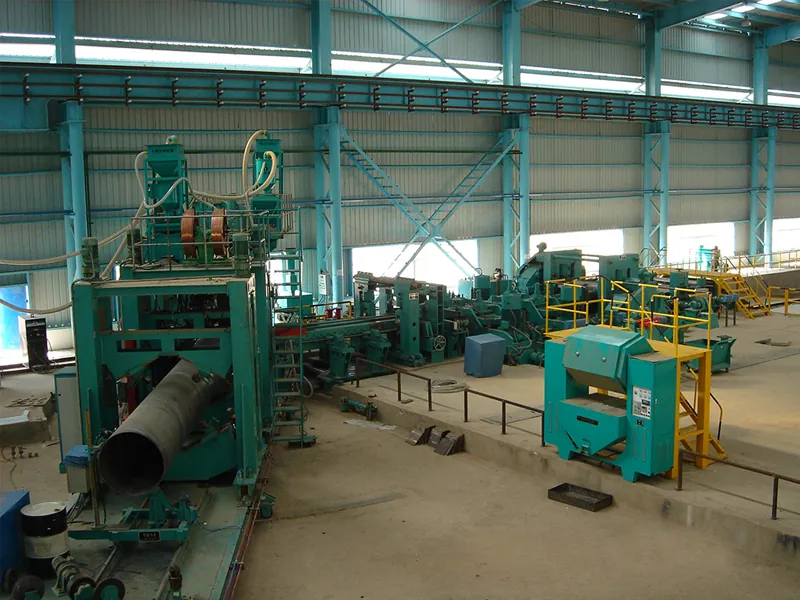
All high-strength, large-diameter steel pipes for large infrastructure projects start the same way: as a flat steel spool fed intoSSAW pipe welding line. This equipment, also known as a spiral welded pipe making machine or spiral pipe production line, converts a coil into a continuous spiral submerged arc welded pipe with permanent structural integrity.
These pipes are widely used in oil and gas transportation, municipal water systems and foundation construction. This article looks at how the production line works, the technical features that make it stand out, and the applications where it brings the most benefit.
What is Spiral Welded Pipe (SSAW) Production Line?
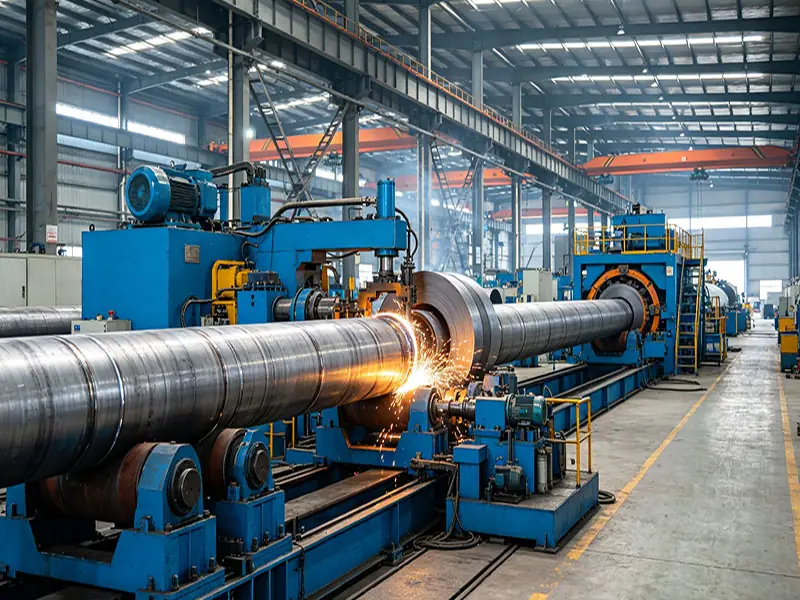
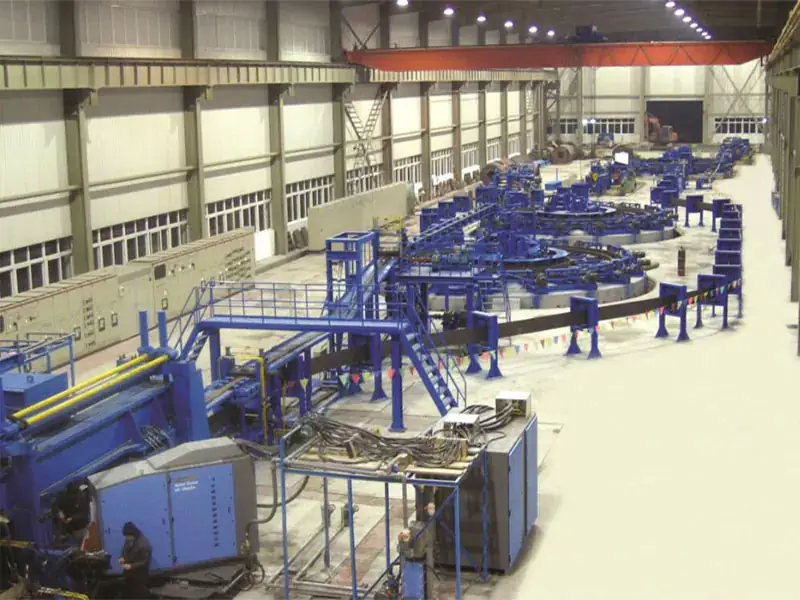
The spiral welded pipe production line is a continuous production system designed to shape steel strip into a cylindrical shape and permanently join the seam using submerged arc welding. At its core, spiral pipe forming machine feeds the aligned, edge-prepared strip at a precisely defined angle, passing it through a series of forming rolls that gradually bend the material into a spiral tube. Immediately after this, internal and external submerged arc welders deposit the weld metal under a protective layer of flux, creating a spiral weld with full penetration. The result is pipe welding line for the production of spiral welded pipes capable of producing pipes with consistent dimensional accuracy and weld integrity on one continuous production line.

Key Features and Benefits
Full diameter coverage from Φ219mm to Φ3000mm
The range of pipe welding lines for the production of spiral pipes covers a wide range of diameters, from 219 mm to 3,000 mm, covered by several model configurations rather than one fixed installation. This portfolio allows manufacturers to meet the needs of medium-sized municipal pipelines and ultra-large oil and gas transmission networks within one product family.
Stable spiral forming of steel strip using three-roll technology
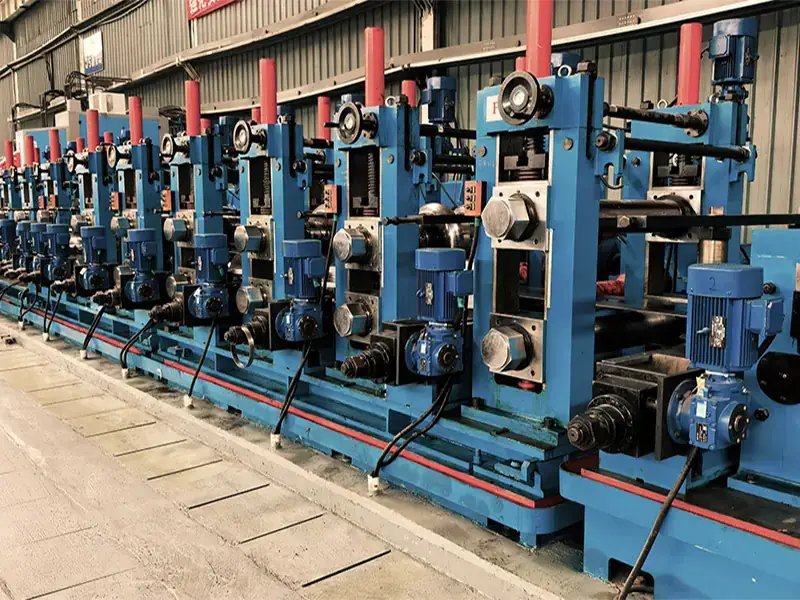
Forming stability is achieved through the three-roll bending principle built into the spiral pipe forming machine. As the strip passes through several sets of rolls, it is gradually bent in a continuous spiral path. Operators can fine-tune the forming angle to switch between tube diameters without changing the entire tool setup, providing tight out-of-round control even when processing high-strength API grades.
Reliable internal and external submerged arc welding and multi-stage weld testing
Dual submerged arc welding torches located inside and outside the pipeline in series, often in a two-wire configuration for higher deposition rates and smoother weld profiles. This is immediately confirmed by automatic online ultrasonic inspection that scans 100% of the weld length, backed up by offline X-ray inspection and a fully automatic hydrostatic tester. Each tube comes out SSAW pipe welding line having passed multi-layer quality control, ensuring both volumetric integrity and tightness.
High automation to reduce labor costs and improve efficiency
A fully integrated PLC system - usually Omron based - combined with a Eurotherm DC drive unit controls the entire line, from unwinding and edge milling to cutting and final inspection. Automated processes, including continuous ultrasonic flaw detection, minimize manual intervention and ensure consistent production rates, which directly translates into lower labor costs per ton.
Fully customized line configuration depending on specification and site conditions
Not everyone spiral pipe production line must be identical. The equipment is designed taking into account the client's target product range, annual production volume and plant area. The layout, drive power (180-530 kW installed power, scalable depending on model size) and auxiliary stations are all tailored to the customer's needs - from compact workshops for smaller diameter lines to large diameter models covering up to 30 m x 180 m.
Capacity and specifications
Before finalizing a coil welding line configuration, buyers typically check the diameter range, wall thickness, coil compatibility, and installed capacity to suit the scope of their project. The table below shows the technical characteristics of this carbon steel pipe welding line.
| Parameter | Specification |
| External diameter | φ219 – φ3,000 mm |
| Wall thickness | 3 – 25.4 mm |
| Pipe length | 6 – 12.5 m |
| Coil width | 400 – 2,000 mm |
| Roll weight (t) | 10 – 40 t |
| Compatible steel grades | Q235B, Q355B; API 5L Classes A, B, X42, X46, X52, X56, X60, X65, X70 |
| Annual capacity | 10,000 – 100,000 t/year |
| Installed power | 180 – 530 kW |
| Forming an angle | 35° – 80° |
| Maximum step | 2,000 mm |
| Forming/welding speed | 0.5 – 2.0 m/min |
| Control system | Omron PLC + Eurotherm DC drive |
| Standard inspection blocks | Automatic Online Ultrasonic Inspection, X-Ray Inspection, Fully Automatic Hydrostatic Tester |
SSAW Manufacturing Process: From coil to finished pipe
Raw material preparation - roll loading, unwinding, leveling, cutting and butt welding
The reel machine positions the strip roll on the decoiler, after which the strip passes through a multi-roll leveler to relieve internal stress. The scissor butt welding machine connects the end of one roll to the head of another, providing a continuous flow throughout the entire volume. pipe welding line for the production of spiral welded pipes.
Edge processing and pre-forming - rotary cutting, edge milling, feeder, pre-bending and guide plate
The edges of the strip are trimmed either by rotary cutting or edge milling to achieve precise widths and clean preparation for welding. The pinch rolls and feeder move the strip forward at a controlled speed, while the pre-bending device and guide plates create ideal entry conditions before the strip reaches the forming stand.
Spiral molding and welding - forming, internal welding, external welding, cutting
Inside spiral pipe forming machine, the strip is bent around a set of three-roll formers and fed at the selected forming angle. The inner welding head makes the root pass, which is immediately followed by the outer welding head. The pipe is then cut to length before moving to the inspection area.
Ultrasonic and online quality control - stretching, X-ray inspection, hydrostatic inspection
The cut pipe is pulled out and transferred to the control area. It is subjected to real-time ultrasonic scanning for weld defects and then TV X-ray inspection for additional volumetric inspection. Hydrostatic testing increases the pressure in the pipe to a specified level, monitoring any pressure drop and creating a traceable test record.
Finishing and Storage - Facing and Chamfering, UT, Labeling, Storage
Finally, an automatic trimming and beveling machine accurately processes both ends of the pipe to create the required bevel geometry for field welding. After the final ultrasonic recheck and application of identification marks, the finished pipe is transported to the warehouse.
Main equipment and components
Spiral molding machine
Based on the principle of three-roll bending, it continuously forms the strip into a spiral tube, and the forming angle directly determines the diameter of the finished tube.
Internal and external submerged arc welding machines
Wire feed systems feed filler metal into the arc zone under a grainy layer of flux. The double-wire, double-arc configuration increases deposition rates and provides a smooth, uniform bead profile.
Online Automatic Ultrasonic Inspection System
Piezoelectric transducers generate ultrasonic waves of 0.5–15 MHz, which propagate along the helical weld. Any crack, lack of fusion or porosity reflects a signal that the system uses to accurately identify and mark the defect in real time, covering 100% of the weld.
Fully automatic hydrostatic tester
Seals both ends of the pipe, fills the pipe with high pressure water and holds the pressure for a specified time, continuously recording pressure curves, checking the overall tightness and strength of the pipe.
Automatic Facing and Chamfering Machine
The rotating cutting head, equipped with trimming and beveling tools, processes both ends of the pipe simultaneously, providing flat ends and precise weld bevels to meet on-site assembly requirements.
Cold Pipe End Expander
The hydraulic expansion head enters the end of the pipe and expands radially, applying controlled cold plastic deformation to relieve residual welding stresses and ensure end diameter tolerance within 2mm, greatly improving geometric accuracy.
Industrial Application
Water management and transport infrastructure
The water and transport infrastructure sector includes applications such as piled bridge foundations, hydraulic pressure pipes and dredging pipelines. In these structural design projects, spiral welded pipes serve as the main support material.
Pipelines for transporting oil and gas
The oil and gas transportation sector represents the largest application market forspiral welding machines. In natural gas pipelines, SSAW pipes are used in approximately 70% of applications, making them the main pipe material in this segment.
Municipal water supply and infrastructure
SSAW pipes occupy a significant share of 63% in municipal water transportation projects. Their cost-effectiveness and ability to produce large diameters make them well suited for municipal water mains, sewer systems and drainage culverts.
Industrial, new energy and structural applications
Growing demand is seen in the transportation of chemical fluids, wind turbine foundation piles and steel building supports. This segment, although smaller, is expanding rapidly as renewable energy infrastructure expands.
Engineering Problems and Solutions in SSAW Pipe Manufacturing
Defect formation: Prevents edges from curling and seams from moving
AOperator of a pipe welding line for the production of spiral pipes observed a “raised edge” defect along the resulting weld, which made subsequent welding of the circumferential seam difficult and increased the risk of damage to the base metal during internal grinding of the weld.
The problem was solved by optimizing the strip edge pre-bending unit, increasing the accuracy of the rotational shear and adjusting the forming angle in accordance with the working window of 45°–65°. Improved vertical roll profiles helped stabilize strip movement through the forming section.
After these adjustments were made, the defect was effectively corrected and the downstream assembly returned to normal, stable operation.
Weld quality issues: Elimination of saddle and counter weld profiles
The constant "saddle" internal concavity and external "fishback" convex resulted in excessive weld reinforcement, resulting in stress concentrations, increased pumping energy losses, and plating problems.
To address this issue, engineers adjusted the positioning and wire angles of both the inner and outer welding heads, fine-tuned the current, voltage and travel speed window, and implemented X-groove edge preparation for thicker walls.
Thanks to these measures, the weld reinforcement was kept below 2.5 mm and a smooth transition between the weld metal and the base material was achieved.
Reliability check: Achieving 100% weld coverage
Because a helical weld is significantly longer than an equivalent straight-seam pipe, the use of selective manual inspection results in a high risk of missing defects such as cracks, porosity, slag inclusions or weld misalignment.
To mitigate this issue, the facility implements a two-step pre-finish welding process that physically separates the forming from the welding, eliminating interference in the process. An online automatic ultrasonic inspection system was also deployed to ensure 100% weld coverage with automatic marking of suspicious areas for subsequent manual UT and X-ray inspection.
This resulted in a fully traceable quality control loop with zero uncontrolled weld length.
Certificates and quality standards
Pipe Product Standards
SSAW pipe welding line can produce pipes that fully comply with API 5L, GB9711-2011 and SY/T5037-2000 standards, covering the entire chain from linear pipe specifications to general structural pipe requirements.
Accessory Certificates
Full upon request pipe welding line for the production of spiral welded pipes can be manufactured and certified in accordance with CE directives and ISO 9001 quality management systems, ensuring seamless acceptance in highly regulated markets.
Compliance of electrical components
Every major electrical component, from PLC modules to motor starters, undergoes mandatory 3C certification to ensure compliance with safety and electromagnetic compatibility requirements.
Frequently Asked Questions
Question 1:What specifications of pipes can the SSAW line produce?
A: Ours SSAW pipe welding line covers diameters from φ219mm to φ3,000mm, wall thicknesses from 3mm to 25.4mm and standard lengths from 6m to 12.5m. Custom length solutions are available depending on project specifications.
Question 2:What steel grades are supported?
A: The line easily processes Q235B and Q355B carbon steels, as well as the entire series of API 5L grades from A, B to X42, X46, X52, X56, X60, X65 and X70, meeting both structural and high pressure piping requirements.
Question 3:What auxiliary equipment is included in the line?
A: Full spiral pipe production line includes decoilers, straightening devices, edge preparation devices (rotary shears or edge milling machines), pinch roll feeding machine, spiral forming machine, internal and external submerged arc welding machines, flux feeding and recovery systems, online/offline ultrasonic testers, x-ray inspection station, hydrostatic tester, facing and chamfering machines, pipe end reamer and conveyor roller tables with anti-corrosion equipment as required.
Question 4:What kind of after-sales support is provided?
A: We send experienced technicians to the customer's site for installation supervision, commissioning and trial production. Comprehensive training covers machine operation, daily maintenance and safety protocols. Each line comes with a 12-month whole-machine warranty, plus ongoing technical support, upgrade services and lifetime maintenance to ensure spiral pipe welding line remains productive throughout its entire life cycle.
Conclusion
From oil and gas arteries to water pipelines under city streets. China Spiral Welded Pipe Welding Line has evolved into a highly automated, highly accurate solution that keeps pace with the world's growing infrastructure needs. Its ability to cover diameters from 219 mm to 3,000 mm, provide stable forming and reliable welding, and integrate comprehensive online inspection makes Spiral welded pipe production line a smart and long-term investment. For any facility whose goal is large-scale production of large-diameter spiral welded pipe, the critical first step is selecting a configurable, standards-compliant and fully supported line.