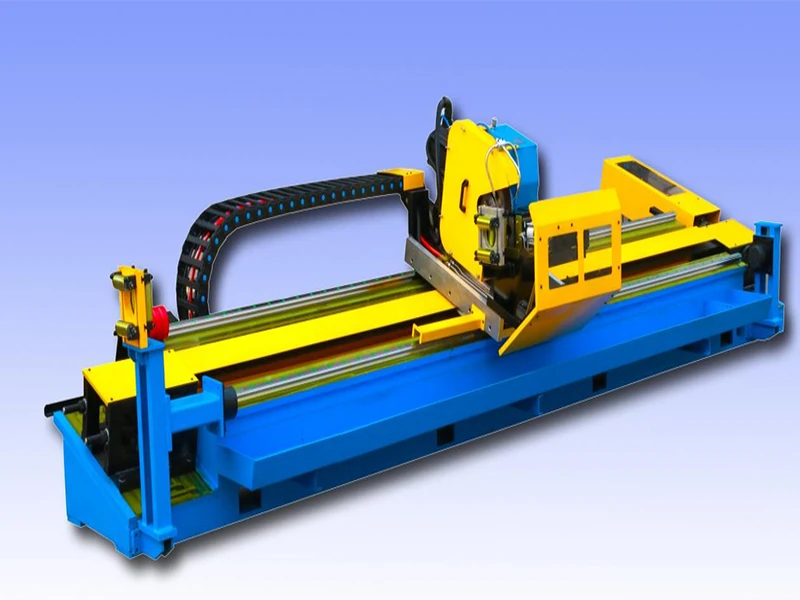
Introduction: Why the right flying saw for cold cutting is important
When assessingERW pipe welding lineMost manufacturers pay special attention to forming, welding and sizing. The cutting system rarely receives the same attention—until something goes wrong.
The flying cold saw sets the final length of each tube coming off the line. When it is out of sync with mill speed or collides with the material being processed, the consequences are immediate: burrs that require reworking, lengths that fail tolerance checks, blades that wear faster than they should, and line stops that accumulate as a result of lost shifts.

The problem is more acute than before. As more pipe manufacturers add high-strength grades to their product line, including the tough high-manganese steels common in CIS supply chains, standard cutting equipment that adequately runs on the Q235 is beginning to show its limits. The vibration increases, heats up, and the clean cut that was previously normal becomes unstable.
This guide examines the factors that determine whetherflying cold saw will support your production or become a bottleneck: cutting ability, length accuracy, material compatibility and ability to integrate with your existing line. Where appropriate, the technical solutions of Wanxin Φ76×4mm flying cold saw are used as a specific reference.
What is a flying cold saw?
The flying cold saw is a mobile cutting system that synchronizes with the continuously moving pipe and cuts it to the specified length without stopping the production line.
The system uses an encoder to measure pipe speed and a controller to calculate the required acceleration and synchronize the saw carriage. During cutting, the carriage matches the speed of the pipe, allowing the blade to produce a clean and precise cut while maintaining continuous performance.
Compared to friction saws, cold-type flying saws have a number of advantages:
- Higher cutting precision
- Less material wastage thanks to thin-kerf blades
- Clean cut surfaces with minimal burrs.
- No heat affected zone or thermal deformation.
These advantages make flying cold saws the preferred cutting solution for modern ERW pipe welding lines.
Determine your production requirements before choosing a cold saw
Before selecting a flying saw for cold cutting, manufacturers must clearly define their production requirements.
Tube diameter and wall thickness range
Wanxin Φ76×4mm flying cold cutting saw is designed for:
- Round pipes: Φ19–Φ76 mm, wall thickness 0.8–4.0 mm
- Square pipes: From 20×20 mm to 60×60 mm, wall thickness 0.8–4.0 mm
- Rectangular pipes: up to 50×70 mm, wall thickness 0.8–4.0 mm
Choosing the right power saw ensures consistent cutting performance and increases blade life.
Coordination of production speed
The flying cold cutting saw must be precisely synchronized with the speed of the ERW pipe welding line. The Wanxin system combines an advanced domestic encoder with an internationally recognized controller and matched drive units to provide precise motion control.
When the line speed fluctuation remains within 5%, the system maintains stable synchronization and maintains high-precision length control.
Types of cutting materials
Material selection is often overlooked when writing equipment specifications.
Wanxinflying cold saw suitable for cutting:
- Q195
- Q235
- QSTE700
- QSTE980
It is also capable of processing carbon, alloy and stainless steel. When discussing a project with a supplier, it is important to provide a complete list of materials that will be processed, including the most durable grades expected in future production.
Evaluation of cutting accuracy and length control efficiency
Length accuracy directly affects product quality and material utilization.
Encoder based synchronization technology
Accurate cutting depends on precise synchronization between the moving pipe and the saw carriage.
Wanxin flying cold cutting saw uses an advanced encoder to continuously control the pipe speed. A high-performance controller processes this information in real time and coordinates the drives to ensure the saw carriage matches the pipe speed throughout the cutting cycle.
This closed-loop control system allows the machine to compensate for minor changes in line speed while maintaining consistent cutting accuracy.
What level of accuracy should I expect?
In production environments where line speed fluctuations remain within ±2%, Wanxin flying cold cutting saw provides:
Cutting length accuracy:1000-1200 mm ±1.5 mm
This level of repeatability helps reduce scrap, minimize material wastage and improve downstream production consistency.
Can a cold saw cut high-strength steel?
For manyERW tubemillmanufacturers, this is one of the most important questions when choosing a cold action flying saw.
Common Problems When Cutting High Strength Steel
Many production lines are set up to work with standard grades such as Q235. However, when machining high-strength steels, operators often encounter:
- Strong blade vibration
- Excessive heat generation
- Partial cutting
- Stretch the burrs at the bottom of the tube
- Reduced blade life
These problems often lead to additional finishing work and production interruptions.
Why steel grades in the CIS and Eurasia countries are more complex
Steel coils produced in countries such as Russia, Uzbekistan and Kazakhstan often contain higher levels of alloying materials and are stronger and more prone to work hardening.
These materials typically have higher strength and shear strength, making them more difficult to cut than regular carbon steel. If cutting parameters are not optimized, the blade may rub rather than cut effectively, resulting in excessive heat, rapid wear and burr formation.
Features you need to cut high-strength steel reliably
To solve these problems, Wanxin has implemented several key solutions.
Special carbide-tipped saw blades
Special carbide blades designed for high-strength steels withstand higher cutting forces and frictional heat than general purpose blades.
Optimized low speed, high torque cutting strategy
The system uses a cutting method based on:
- Lower cutting speed
- Controlled feed rate
- Higher output torque
This strategy reduces heat generation while ensuring each tooth effectively removes material, preventing carbon deposits and improving cut quality.
Upgraded double clamp mechanism
A reinforced dual clamp system secures the tube on either side of the cutting point, minimizing vibration and preventing blade chatter.
With these improvements, the Wanxin flying cold cutting saw can reliably process QSTE700, QSTE980 and other high-strength materials, while eliminating the problems of stretching burrs that are commonly observed when using conventional equipment.
Adaptation for existing pipe welding lines
Each ERW production line has unique layout requirements.
To ensure smooth integration, Wanxin provides customizedflying cold saw solutions based on the customer's production line drawings.
The machine can be designed to match existing:
- Mill layouts
- Passage line height
- Tube entry and exit positions
- Material handling systems
For manufacturers replacing friction saws or retrofitting older cutting equipment, custom solutions help minimize installation time and reduce retrofit costs.
How a High Quality Cold Cutting Flying Saw Boosts Your ROI
The value of a cold action flying saw should be measured over its lifespan, not just the purchase price.
Key benefits include:
Reduce material waste
Fine-kerf blades and precise length control improve material utilization and reduce waste.
Reduced maintenance costs
Optimized cutting parameters, correct blade selection and stable clamping reduce blade consumption and help prevent unexpected downtime.
Higher production efficiency
Reliable cutting performance minimizes interruptions, maintains production continuity and allows the ERW mill to operate at design capacity.
Questions to Ask a Flying Cold Cutting Saw Supplier Before Purchasing
Before making a purchasing decision, ask potential suppliers the following questions:
What materials have been successfully tested?
Ask for evidence of successful cutting of grades of steel similar to those used in your production, especially high-strength materials such as QSTE700 and QSTE980.
What cutting accuracy can be guaranteed?
Request documented specifications for length tolerances and the operating conditions under which they are achieved.
Is customization available?
Confirm whether the supplier can design the equipment to suit your production line layout and installation requirements.
What technical support is provided?
A qualified supplier should provide support for blade selection, parameter optimization, commissioning and troubleshooting.
Conclusion
Choosing the right oneflying cold saw necessary to maintain product quality, reduce waste, and maximize ERW plant productivity. Manufacturers should evaluate equipment based on cutting accuracy, material compatibility, high-strength steel capabilities, and customization capabilities, rather than focusing solely on purchase price.
The Wanxin Φ76×4mm flying cold cutting saw combines precise length control, proven performance on challenging steel grades such as QSTE700 and QSTE980, and customized engineering support for existing production lines. By focusing on these critical factors, pipe manufacturers can select a cutting solution that will provide long-term efficiency, reliability and profitability.