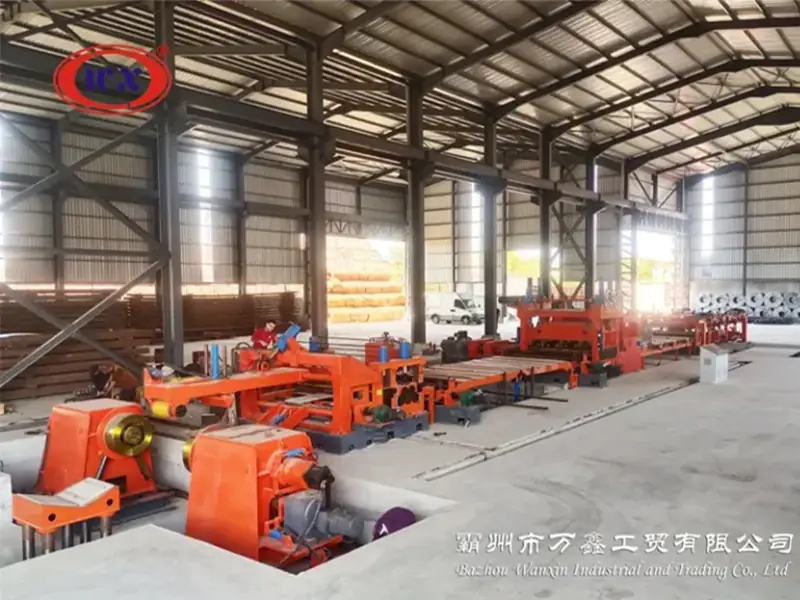
Why choosing the right cross-cut line is so important
Choicecross cutting lineis an important investment decision for steel processors as the right equipment directly impacts production efficiency, sheet quality, material utilization and operating costs. A line that does not meet your material requirements or production conditions can result in poor flatness, inaccurate cutting, excessive scrap, and unexpected downtime.
Whether you are updating an existingsteel slitting lineor investing in your first roll handling system, it is important to understand the key factors before purchasing. This guide examines seven critical factors, including material compatibility, straightening performance, cutting accuracy, automation, supplier capabilities and total cost of ownership, to help you select a cross-cut line that will provide reliable, long-term performance.
Factor 1:Material compatibility and processing requirements
The first step when choosing a slitting machine is to understand the materials that need to be processed. The equipment must not only meet current production requirements, but also provide sufficient capacity for future product expansion.
Types of materials
Different materials require different machine configurations due to differences in strength, surface sensitivity, and processing characteristics.
- Hot rolled coil: Requires high leveling ability and high cutting force due to mill scale and material stress.
- Cold rolled coil: Requires precise feeding and precision cutting to maintain tight dimensional tolerances.
- Galvanized steel: Treatment systems are required that minimize surface damage to protect coating quality.
- Stainless steel: Requires rigid machine structures and durable components due to high strength and hardening characteristics.
- Aluminum: Benefit from non-marking rollers and precise tension control.
- Silicon steel: Electrical applications require excellent flatness and burr-free cutting.
Material dimensions and mechanical properties
Before choosing a machine, determine the maximum thickness, strip width, roll weight and yield strength of the material. These factors determine the required decoiler power, leveling performance, cutting ability and overall machine design.
The CTL line selected must cover the entire processing range, not just average production requirements. Matching the equipment power to the dimensions and mechanical properties of the material ensures stable operation, consistent sheet quality and a longer service life.
Factor 2: Straightening performance and sheet flatness quality
The leveling system determines whether the slitting machine can consistently produce flat sheets from web material. Because different steel grades and thicknesses create different levels of residual stress, leveling capability is one of the most important factors when selecting a CTL line.
Can the leveling system handle your range of materials?
Steel coils may contain defects such as edge waves, center buckles or crossbow marks after unwinding. A properly designed leveling system should eliminate these problems for a full range of materials, including varying thicknesses, widths, and yield strengths.
When evaluating a machine, consider whether the leveling system can maintain consistent flatness during continuous production and product changes.
What should you evaluate?
Key factors include:
- Machine frame rigidity
- Leveling roll support design
- Flexibility of customization
- Flatness stability during production
A suitable leveling system reduces post-processing problems, minimizes rework and improves overall product quality.
Factor 3:Cutting technology and precision
The cutting system directly affects edge quality, production efficiency, equipment longevity and maintenance requirements. Most cross cutting lines use hydraulic or mechanical cutting systems. The correct choice depends on the material requirements and production goals.
Choosing the right cutting technology
Hydraulic shearsUse hydraulic cylinders to generate cutting force, ensuring stable and constant cutting performance. They are generally suitable for thicker materials and high-strength steels as they provide smooth cutting force and overload protection.
Mechanical shears use a flywheel and crank mechanism to achieve fast, repeatable cutting cycles. They are typically used for high volume production of thinner materials.
| Feature | Hydraulic shears | Mechanical cutting machine |
| Cutting force | Constant, uniform force throughout the entire cutting stroke. | Force peaks during the launch cycle |
| Typical Applications | Medium and heavy materials | Small-scale large-scale production |
| Speed characteristics | Adjustable cutting speed | High fixed operating speed |
| Overload protection | Hydraulic pressure release protection | Mechanical components may be damaged if overloaded. |
| Maintenance | Checking the hydraulic system and replacing seals. | Regular lubrication and maintenance of the clutch or brake. |
Experience cutting accuracy
Modern CTL machines typically use encoder-based length measuring systems to synchronize feed and cutting. A properly configured system can provide length accuracy of up to ±1 mm while maintaining clean, square cut edges.
When choosing a cutting system forsteel coil cutting machineConsider material type, thickness range, production volume and required dimensional accuracy. Choosing the right configuration increases productivity while reducing maintenance and operating costs.
Factor 4:Automation and control system capabilities
Automation plays an important role in improving production efficiency, operational stability and overall equipment performance. When assessingcross cutting line, consider not only the mechanical design, but also whether the control system can simplify operation and support future production upgrades.
Automation features that increase efficiency
A modern CTL line should include a PLC control system and an HMI touch interface, allowing operators to set parameters, monitor machine status and control production processes through a centralized control panel.
Features such as servo feed systems and recipe management help improve length accuracy, reduce setup time and minimize manual adjustments when switching between different products.
Smart diagnostics and future integration
Diagnostics capabilities help operators and service engineers quickly identify equipment problems, reducing troubleshooting time and minimizing downtime.
For businesses planning future automation upgrades, machines that support industrial communication interfaces can provide easier integration with manufacturing control systems, remote monitoring platforms and Industry 4.0 solutions.
Factor 5:Manufacturer experience and engineering capabilities
A slitting machine is a long-term manufacturing investment, and the manufacturer's engineering capabilities directly impact equipment reliability, production efficiency, and future maintenance costs.
A supplier with extensive coil processing experience understands the challenges associated with different materials, thickness ranges, production speeds and operating conditions. This experience influences key design decisions including machine rigidity, alignment configuration, cutting selection, automation integration and component durability.
Cooperation with an experienced manufacturer reduces project risks during the design, installation, commissioning and start-up of equipment production.
Questions to ask before choosing a supplier
Before you buycross cutting line, try asking:
- How many similar CTL lines have you supplied for comparable materials and thickness ranges?
- Can you provide technical recommendations based on our coil specifications and manufacturing requirements?
- What engineering standards are used for machine design, leveling accuracy, and component selection?
- Do you provide installation support, operator training and technical assistance?
- Can you share your experience in implementing similar projects?
Plant Capability Assessment and Quality Control
Manufacturers with in-house machining, assembly, testing and quality control processes can better maintain equipment consistency and production reliability.
Certifications such as ISO 9001 demonstrate standardized quality management practices, but should be evaluated in conjunction with actual project experience, engineering capabilities, and technical support resources.
Factor 6:After-sales service and technical support
A cut-to-length machine requires reliable technical support throughout its entire lifespan. Effective after-sales service helps reduce downtime and ensure stable production.
Installation, training and commissioning
Professional installation supervision ensures that the production line is aligned and set up correctly from the very beginning. Operator training helps production teams understand equipment operation, safety procedures, and basic maintenance requirements.
The complete commissioning process must test key performance factors including sheet flatness, cutting accuracy and safety features.
Availability of spare parts
Critical components such as cutting knives, straightening rolls and hydraulic seals must be available to minimize production disruptions.
Before purchasing, check the availability of spare parts, delivery times, and whether the supplier provides complete technical documentation for future service.
Preventive Maintenance Support
Suppliers that provide maintenance schedules, lubrication recommendations, and remote diagnostic support help prevent unexpected failures and improve equipment reliability.
Factor 7: Total Cost of Ownership and Return on Investment
The purchase price is only part of the investment in a cross cutting machine. A full assessment should include energy consumption, maintenance requirements, production efficiency, material use and long-term performance value.
What helps reduce total cost of ownership?
A well-designed CTL line can reduce operating costs by:
- Improved material utilization and reduced waste
- Reducing labor requirements through automation
- Reduced downtime due to stable machine operation
- Reduced maintenance costs thanks to reliable components
These benefits help reduce the overall cost over the life of the equipment.
What provides return on investment?
Return on investment is achieved by increasing production capacity and increasing production flexibility. Higher processing efficiency allows more material to be processed in the same operating hours, and consistent sheet quality reduces the need for rework during downstream processes.
In-house length processing also allows manufacturers to produce sheets based on actual demand, reducing reliance on large inventories.
Before making your final decision, compare not only the price of the equipment, but also the expected production capacity, operating costs, maintenance requirements and productivity improvements.
How to choose the right cross cutting line model
The right steel cutting machine must meet your actual production requirements, including material thickness, strip width, coil weight and expected productivity. Rather than selecting equipment based solely on current production needs, processors should consider future product expansion and select a configuration with sufficient capacity.
The following CTL series provide different ranges for processing different steels:
| Model series | Thickness range | Bandwidth Range | Maximum reel weight | Suitable Applications |
| CTL1250 Series | 0.3–12 mm | 600–1250 mm | Up to 25 tons | General steel processing, service centers, construction products |
| CTL1600 Series | 0.3–16 mm | 900–1600 mm | Up to 30 tons | Processing of medium-width sheets and various steel applications |
| CTL2000 Series | 0.4–20 mm | 1000–2000 mm | Up to 30 tons | Large panels, structural elements and heavy structures |
| CTL2500 Series | 2–25 mm | Up to 2500 mm | Up to 35 tons | Plate processing, shipbuilding, pipe manufacturing and heavy engineering. |
When choosing a CTL model, the most important factors are maximum material thickness, maximum roll width, roll weight and required production speed. The line you select should comfortably handle your highest-demand products, maintain stable operation, and allow for future capacity expansion.
To obtain accurate recommendations, steel processors should provide the manufacturer with their material specifications, production goals, and downstream processing requirements before finalizing equipment configurations.
Why Choose WANXIN Cross Cutting Line
After defining your manufacturing requirements and understanding the key selection factors, the final step is selecting a manufacturer with proven engineering capabilities. WANXIN provides complete cutting-to-length solutions designed for steel processors who require reliable operation, precise sheet processing and long-term production stability.

Complete CTL solutions for various steel processing requirements
WANXIN develops steel cross-cutting lines covering a wide range of steel processing applications, from thin sheet production to heavy sheet processing. The product range supports thicknesses from 0.3mm to 25mm and strip widths up to 2500mm, allowing processors to select equipment based on their actual material requirements.
Available configurations include:
- CTL1250 Series for narrow to medium width applications with thicknesses up to 12mm
- CTL1600 Series for wider sheets and processing medium thicknesses up to 16 mm
- CTL2000 Series for large width applications requiring processing power up to 20 mm
- CTL2500 Series for heavy sheets up to 2500 mm wide and up to 25 mm thick
Specially designed leveling and cutting system
Cutting flatness and accuracy directly influence subsequent processes such as laser cutting, bending, welding and forming. WANXIN CTL lines use rigid multi-roll leveling systems and precision feeding technology to improve sheet flatness and maintain stable cutting performance.
Depending on thickness, strength and production requirements, the line configuration can include suitable cutting solutions to ensure reliable cut quality and long service life.
Automated production for increased efficiency
Modern steel processing requires more than just mechanical performance. WANXIN CTL machines integrate PLC-based control systems, HMI operating interfaces, servo length measurement and automatic parameter control to simplify operation and improve production stability.
These automation features help reduce manual setup time, minimize operator error, and maintain consistent productivity during continuous production.
Manufacturing experience and global project support
With more than 30 years of experience in steel processing equipment manufacturing, WANXIN has accumulated experience in designing and manufacturing coil processing lines for various industrial applications.
Relying on an ISO 9001 certified quality management system and extensive manufacturing resources, WANXIN provides complete project support, including equipment design, manufacturing, installation assistance, commissioning and maintenance.
For steel processors investing incross cutting lineSelecting a supplier with both manufacturing capabilities and application experience helps reduce project risk and ensures reliable long-term operation.
Frequently Asked Questions
Question 1:What kind of cutting accuracy can a modern CTL machine provide?
A: Modern CTL machines equipped with an encoder-based fixed length system can achieve ≤ ±1mm length error with flat square ends, ensuring sheets are ready for use.
Question 2:What certifications should you look for when choosing a cross cutting equipment manufacturer?
A: Look for manufacturers with ISO 9001 quality management system certification. For equipment intended for specific markets, also ensure that the machine meets the relevant regional safety standards, such as CE marking.
Question 3:How is heavy cutting to length equipment typically delivered?
A: Equipment is usually disassembled and shipped in containers. Standard sea freight FOB or CIF is the most economical option. Typically delivery to major ports around the world takes 30-45 days. The identified supplier will handle customs documentation, marine insurance and loading controls to reduce delivery risks.
Conclusion
Choosing the right slitting machine requires more than just comparing specifications or initial equipment costs. Steel processors need to consider their material requirements, leveling productivity, cutting accuracy, automation capabilities, supplier experience, after-sales support and long-term operating costs.
A properly configured CTL line can improve sheet quality, increase production efficiency, reduce material waste, and provide greater flexibility for future business growth. By carefully evaluating these factors and working with an experienced manufacturer, processors can invest in equipment that will provide reliable performance throughout its life.
WANXIN offers four CTL series, covering thicknesses from 0.3mm to 25mm and widths up to 2500mm, allowing processors to match equipment directly to their material range rather than settling on a general purpose line. To find the right configuration for your specific coil characteristics and production goals, contact WANXIN's engineering team for customized recommendations.